
When you go downstairs to the basement and notice the foundation wall is leaning in, alarm bells should be ringing. This is more than a cosmetic hiccup. A bowed wall is a sign that your foundation is under significant pressure and beginning to fail.
Horizontal or diagonal cracks are often the first warning sign homeowners notice. Then the wall slowly starts to noticeably bulge inward.
The good news is that permanent repair solutions are available. In this article, we’re sharing what causes bowed walls, how they can be fixed, and who you can contact for help.
What Causes Basement Walls To Bow
Several factors can create pressure against the foundation, causing basement walls to bow over time.
- Hydrostatic Pressure: When the soil around your foundation becomes saturated with water, it becomes heavy and pushes against the walls. This force, known as hydrostatic pressure, can cause walls to crack or bend.
- Poor Drainage: Rainwater, sprinkler runoff, or other uncontrolled water sources that aren’t properly directed away from the house can pool around the foundation, soak into the soil, and lead to hydrostatic pressure.
- Expansive Soil: Clay soil expands when wet and shrinks when dry. This movement places uneven pressure on foundation walls, which can contribute to bowing, leaning, or cracking.
- Freeze-Thaw Cycles: During winter, frozen ground expands, and as temperatures rise, it contracts. While these freeze-thaw cycles are not normally a primary culprit of bowed walls, they can place additional stress on an already deficient wall.
When to be Concerned about a Bowed Foundation Wall
Foundation walls should be measured to determine how much lateral deflection (movement inward) they are experiencing. If a foundation wall moved inward less than 1/2 inch, then it normally does not warrant a strengthening or stabilization repair, although repairs are sometimes performed as a precaution due to a real estate transaction or before a renovation project, such as a basement finish or remodel. Generally, once a wall reaches 3/4 inch of inward lateral movement, most professionals will recommend a repair to prevent further movement.
If any of the following apply, then the wall may need an urgent repair to avoid safety concerns:
- Over 3 inches of movement
- Daylight showing at the top of the wall where the sill plate no longer sits on the concrete foundation wall
- Severe cracking, especially shear cracking or a severe horizontal crack
- Loss of vertical support of the main house structure
- Recent changes in the symptoms that may indicate that the movement is highly active
Permanent Bowed Wall Repair Methods
Once it is determined that the foundation needs a lateral repair for a bowed wall, there are various repair methods that are commonly used. Which method is best will depend on each particular wall, its level of movement, and site conditions, among other items.
It’s important to note that the success of all three repair methods listed below will depend on proper drainage improvement along the wall being repaired, and drainage must be maintained throughout the life of the structure. This includes properly sized and unobstructed gutters and downspouts, downspout extensions piping the water away, grade improvements to provide a positive slope, and ensuring concrete slabs have not settled towards the wall or have a significant void below that attracts water.
Wall Anchors
Wall anchors are a very common repair method that uses steel plates and rods in order to anchor into the exterior soil for resistance. This method is a good candidate for sites that have no exterior obstructions, and when the overhead joist system cannot be utilized, either because it runs in a parallel direction to the wall, the joists are not continuous due to a staircase, or because of obstructions in the joist cavities, such as utility lines and ducts.
This method involves installing wall plates on the interior side of the bowed wall and earth anchors in the ground outside. Both components are connected by steel rods, which may need to be tightened over time as the soil compresses under load or experiences washout.
Carbon Fiber Straps
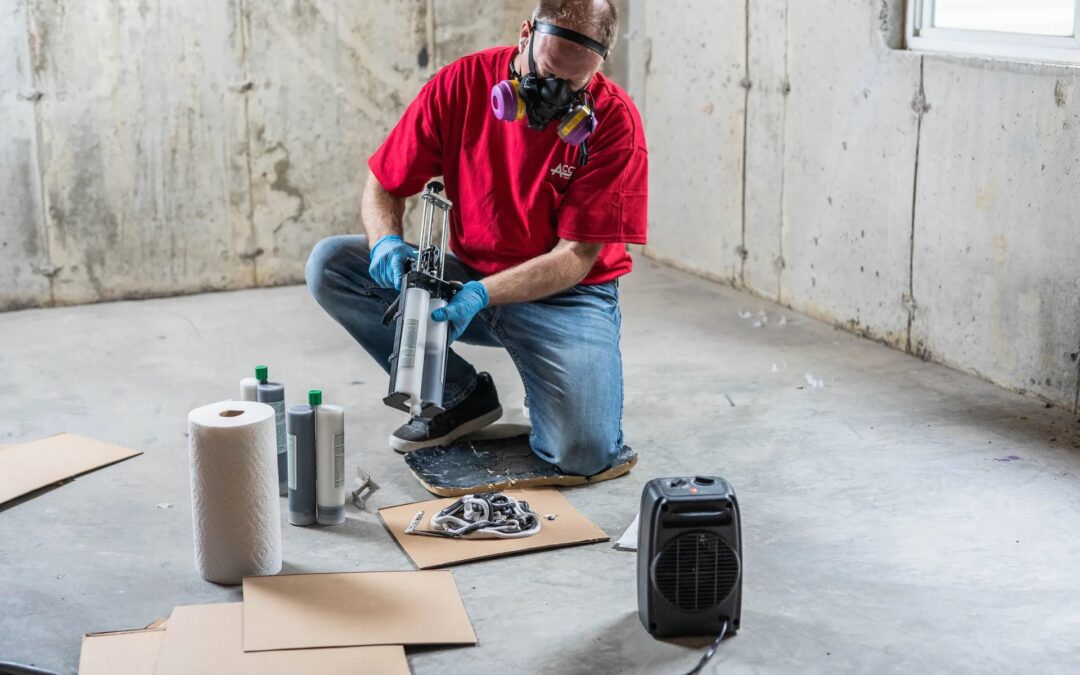
Carbon fiber vertical reinforcement straps are an ideal option when the joist system runs perpendicular to the foundation wall. Thin, strong carbon fiber straps are secured to the wall with epoxy, which creates a rock-solid bond. Straps are spaced along the length of the bowed section, usually 4 to 6 feet apart. A uniform distribution is key to its effectiveness.
This repair must be paired with a steel angle bracket system, or equivalent, that stops the top of the wall from tipping inward. The carbon fiber provides tension capacity to the interior side of the foundation, with a minimally invasive installation process.
Steel I-Beams
Similar to the carbon fiber repair option, steel I-beams stop the top of the wall from tipping inward and provide tension capacity to the interior side of the foundation wall. I-beams are installed vertically and anchored to the basement floor and ceiling joists. They’re spaced approximately 5 to 6 feet apart to redistribute lateral pressure caused by soil and water.
This method doesn’t correct existing bowing and takes up roughly 6 to 12 inches of interior basement space. Yet one of its biggest advantages is that, similar to the carbon fiber option, it doesn’t require any external excavation, making it ideal for homes with limited outdoor access.
Expertise You Can Trust
The place you call home deserves the attention it needs to be safe and stable for years to come. That’s where Acculift Foundation Repair comes in. Our team is experienced in a wide range of foundation repair solutions and committed to ensuring every project is executed with accuracy and care. Reach out to meet with a specialist and have tailored results that last.