
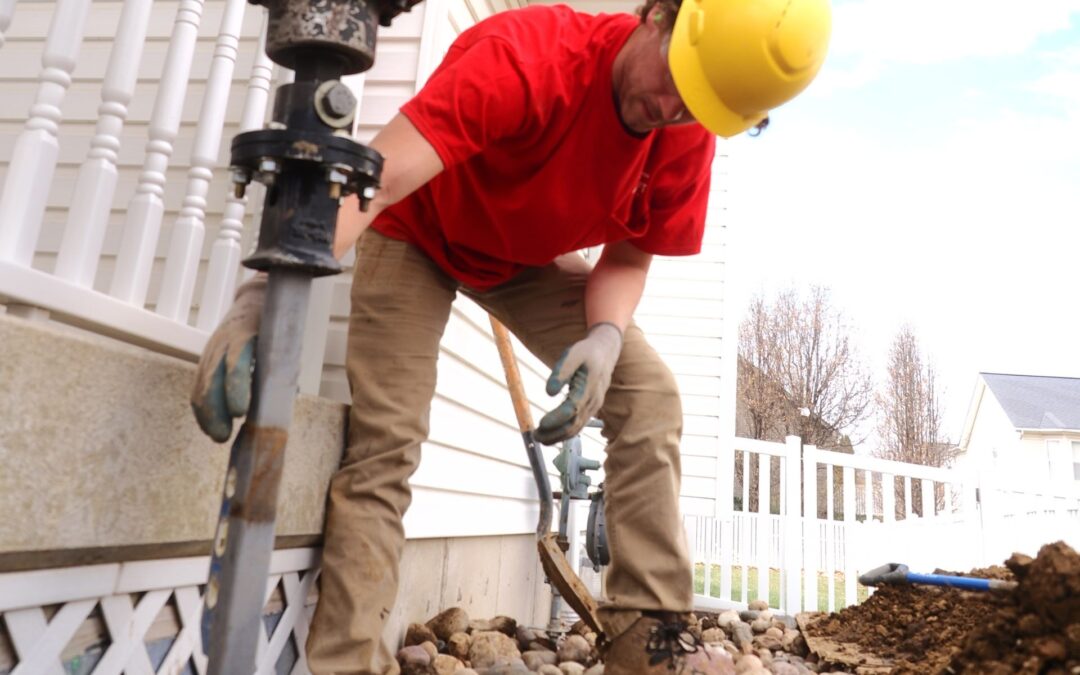
When a foundation begins to settle, the effects become noticeable. There can be cracks in walls, uneven floors, and doors that no longer close properly, among other symptoms that affect the structure’s aesthetics, functionality, and possibly even its value. The most reliable solution is foundation piers, structural elements installed deep beneath the house’s foundation to provide stability.
There are a variety of pier types, but in the Saint Louis region, only steel piers are commonly viewed as permanent and proven solutions. Choosing between two steel pier types, helical piers and push piers, depends on soil conditions, the structure’s condition, and the weight of the house. To help you make an informed decision, our experts are sharing what to know about the two.
What Are Helical Piers?
Helical piers, also known as helical piles or screw piles, are steel shafts with a spiral, corkscrew-shaped blade on one end. Using a hydraulic torque motor, they are rotated into the ground, where they anchor in load-bearing soil or bedrock. In some cases, they can also be installed at an angle to accommodate site conditions or structural needs, adding to their versatility.
For an existing structure, steel brackets are attached to the tops of the piers, which are then secured to the foundation, allowing the structure’s weight to be transferred to stable layers below. For new structures, the piers are driven and topped with a new construction cap before the concrete footing is poured.
Helical piers are the ideal choice for lighter structures or those damaged by previous issues. They are also perfect for pre-construction piers to prevent settlement before it occurs.
What Are Push Piers?
Push piers, also known as resistance piers or push piles, are hollow steel tubes designed to be installed only in a straight, vertical line. Using hydraulic jacks, push piers are driven into the ground until they reach stable soil or bedrock. The weight of the home provides a counterbalance to the piledriving.
Each pier is then connected to the home’s foundation using a steel bracket.
Push piers are the preferred choice for most structures in the Saint Louis region, unless the structure is very light or in fragile condition.
The Differences Between Helical Piers and Push Piers
Both systems are used in foundation repair, but the differences come down to how they are installed and where they perform best. It’s important to use a contractor with substantial experience with both types of piers and the knowledge to determine which is best suited for your project.
- Installation Method: Helical piers are rotated into the ground using a hydraulic torque motor, while push piers are driven straight down using hydraulic rams and the weight of the structure.
- Soil Conditions: Helical piers are capable of supporting loads within a layer of somewhat soft, wet, or expansive soils. Push piers are most effective when they can be driven through layers to reach a very hard, competent soil layer. Since most residential structures do not have soil borings, it is vital that your contractor have extensive experience in the local region so they are familiar with the common soil types and behavior.
- Structural Capability: Helical piers can be used for both light and heavy structures, whereas push piers are more effective for heavy structures because they rely on the weight for installation. Push piers are load-tested during installation, providing an added layer of assurance that they can support the design loads.
Give Your Foundation the Support It Needs
Foundation issues are not something to put off. The sooner you understand what’s going on, the easier it is to fix it properly.
Acculift Foundation Repair has been serving Saint Louis, Missouri, since 1985, providing structural and waterproofing solutions backed by licensed engineers. Every home is inspected carefully, and repair plans are customized to ensure long-term safety and value.
We use only high-quality materials and proven methods to restore the foundation’s strength. Most projects finish within a week, and our team provides a general timeline during each free estimate. To schedule your free estimate and get things back on solid ground, contact us today!